

Venue-specific strategy adaptation for perpetual DEXs

Most traders assume their automated execution strategies will perform identically across different perpetual DEXs. This misconception leads to costly execution failures, unexpected MEV losses, and blown risk limits. Each venue operates with distinct liquidity models, latency profiles, funding mechanisms, and order execution rules. Applying a uniform strategy across venues without adaptation is like using the same tire pressure for highway driving and off-road terrain. Success in automated perpetual DEX trading demands tailoring automated execution strategies to each venue’s unique characteristics, transforming venue diversity from a liability into a strategic advantage.
Table of Contents
- Understanding Venue-Specific Characteristics Of Perpetual DEXs
- Key Risks And Edge Cases In Multi-DEX Automated Execution
- Advanced Adaptation Techniques And Empirical Performance Evidence
- Practical Steps To Implement Venue-Specific Adaptive Strategies And Control Risk
- Explore Mithril’s Powerful Tools For Automated Perpetual DEX Trading
- Frequently Asked Questions
Key takeaways
| Point | Details |
|---|---|
| Venue characteristics demand customization | Each perpetual DEX has unique liquidity models, latency, and funding mechanisms requiring tailored automation strategies. |
| Major risks include MEV and funding desyncs | Over 80% of reverted transactions on L2s stem from strategic MEV, while oracle lag causes funding calculation errors. |
| Adaptive algorithms outperform static approaches | Regime-adaptive strategies delivered +27.6% hedged returns over 748 days versus negative buy-hold benchmarks. |
| Implementation requires simulation and testing | Backtest strategies with venue-specific MEV rates, funding discrepancies, and gas-aware routing before deployment. |
| Multi-DEX aggregation enables unified execution | Platforms connecting 85+ venues normalize heterogeneous data feeds for cross-venue strategy optimization. |
Understanding venue-specific characteristics of perpetual DEXs
Perpetual decentralized exchanges operate on fundamentally different architectural models that directly impact how your automated strategies execute. The two dominant models are Continuous Limit Order Book (CLOB) systems like dYdX and Vertex, and Automated Market Maker (AMM) designs such as GMX and Gains Network. CLOB venues provide traditional order matching with visible depth and price-time priority, while AMMs use algorithmic pricing curves and pooled liquidity.
Latency varies dramatically between venues based on their underlying blockchain infrastructure. Arbitrum-based exchanges typically exhibit 250-400ms block times, while Solana venues can achieve sub-second finality. This timing difference fundamentally alters optimal entry and exit logic. High-frequency scalping strategies viable on Solana may suffer unacceptable slippage on slower chains.
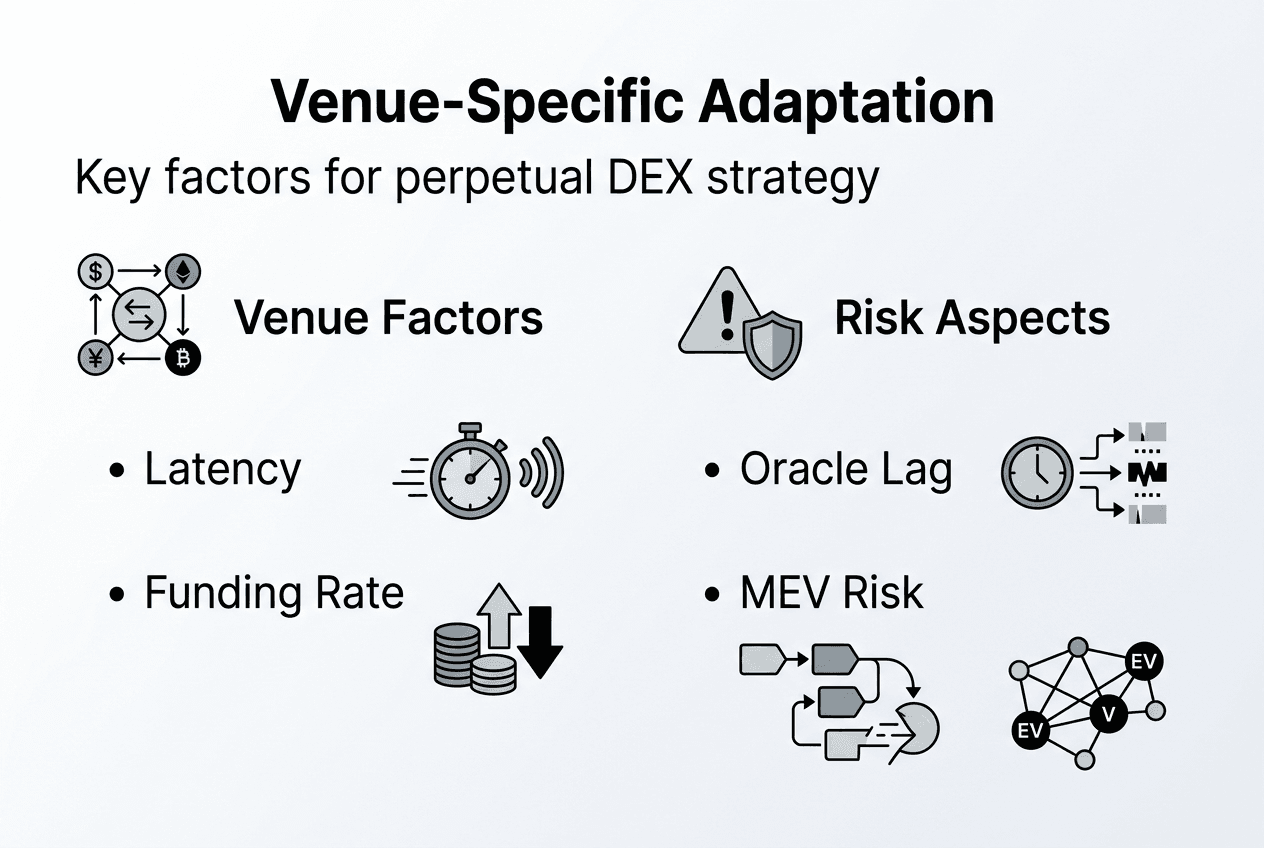
Funding rate mechanisms differ in calculation frequency, oracle sources, and settlement timing. Some venues update funding every hour using Chainlink price feeds, while others recalculate every eight hours with proprietary oracles. These variations create arbitrage opportunities but also introduce desynchronization risks when hedging positions across multiple platforms. Venue-specific strategy adaptation involves tailoring automated execution algorithms to these unique characteristics.
Order book depth and available liquidity fluctuate wildly between venues and trading pairs. A strategy executing $50,000 trades on ETH/USDC might perform flawlessly on one exchange but trigger catastrophic slippage on another with thinner books. Understanding these liquidity profiles prevents your automation from walking into predictable execution traps.
Key venue characteristics requiring adaptation include:
- Liquidity model architecture (CLOB versus AMM pricing mechanisms)
- Block finality and transaction confirmation speeds
- Funding rate calculation methodology and update frequency
- Maximum leverage limits and margin requirements
- Fee structures including maker/taker differentials and gas costs
- Oracle dependencies and potential lag in price updates
Key risks and edge cases in multi-DEX automated execution
Maximal Extractable Value and transaction revert dynamics create a hidden tax on automated strategies operating across rollup-based perpetual DEXs. Over 80% reverted transactions on L2s are equilibrium MEV strategies, not failures. Searchers intentionally submit transactions designed to revert when unprofitable, treating gas fees as option premiums. Your automation must account for this strategic behavior, as naive retry logic amplifies costs without improving execution.

Oracle lag introduces dangerous desynchronization in funding rate calculations across venues. When spot price moves rapidly, different exchanges using different oracle update frequencies will temporarily show divergent funding rates. Traders exploiting this arbitrage face the risk that positions opened during lag periods get liquidated when oracles converge. Simulating these tail risks in automated DEX execution during backtesting reveals edge cases that destroy otherwise profitable strategies.
Cross-margin liquidation cascades amplify losses in ways unique to decentralized perpetual platforms. Unlike centralized exchanges with unified risk engines, each DEX implements independent liquidation logic. A position liquidated on one venue can trigger margin calls on correlated positions elsewhere, creating a domino effect your automation may not detect until capital is already depleted.
Volatility spikes cause gas rate surges that invalidate execution assumptions. During extreme market moves, transaction costs on Ethereum L2s can spike 10-20x within minutes. Strategies with thin profit margins suddenly become unprofitable, yet automation continues executing based on stale gas estimates. Building dynamic gas awareness into your execution logic prevents these silent profit killers.
AMM liquidation mechanics differ fundamentally from CLOB systems:
- AMMs impose slippage caps protecting against cascading liquidations
- CLOB venues incentivize keeper participation through liquidation rewards
- AMM insurance funds absorb losses differently than CLOB socialized loss mechanisms
- Position sizing limits vary based on available pool liquidity versus order book depth
Pro Tip: Simulate venue-specific revert rates during backtesting by injecting random transaction failures calibrated to observed MEV frequencies. This stress test reveals whether your strategy remains profitable under realistic execution conditions rather than idealized assumptions.
Advanced adaptation techniques and empirical performance evidence
Multi-DEX aggregation platforms solve the heterogeneous data problem by normalizing feeds from dozens of venues into unified APIs. Platforms connecting 85+ venues like Keyrock enable your automation to consume standardized order book snapshots, funding rates, and execution endpoints regardless of underlying venue architecture. This abstraction layer lets you focus on strategy logic rather than venue-specific integration complexity.
Reinforcement learning algorithms dynamically optimize execution parameters based on live market conditions rather than static rules. These adaptive systems learn optimal spread widths, position sizes, and rebalancing frequencies by treating each trade as a state-action-reward sequence. Reinforcement learning approaches continuously improve as they accumulate experience across different market regimes and venue conditions.
Hyper-heuristic frameworks search broader strategy spaces by combining multiple optimization techniques. Instead of committing to a single algorithm, these systems dynamically select from a portfolio of heuristics based on current market characteristics. This meta-optimization approach proves especially valuable when venue conditions shift unpredictably.
Delta-neutral basis trading exploits persistent perp-spot price spreads while minimizing directional exposure. By simultaneously holding offsetting perpetual and spot positions, you capture funding rate yields without betting on price direction. Empirical evidence demonstrates the power of adaptive approaches. Regime-adaptive LP bots earned +27.6% hedged returns over 748 days on SOL/USDC, while static buy-hold strategies posted negative returns during the same period.
Solver-based DEX aggregators improve trade execution welfare by 2-5% on large orders by intelligently routing across venues. These systems model the complete execution path, accounting for gas costs, slippage, and price impact to find optimal multi-hop routes that static routing misses.
| Strategy Type | 748-Day Return | Regime Adaptation | Venue Count | | — | — | — | | Static LP Grid | -3.2% | None | Single | | Adaptive LP Bot | +27.6% | Dynamic | Multi | | Buy-Hold Baseline | -8.1% | None | N/A | | Solver Aggregation | +2-5% welfare gain | Route optimization | 85+ |
Pro Tip: Start with perp-spot delta-neutral strategies when learning venue adaptation, as the hedged structure limits downside while you refine execution logic across different platforms. Once comfortable, gradually introduce directional components.
Practical steps to implement venue-specific adaptive strategies and control risk
Begin by systematically analyzing execution conditions across your target venues. Collect historical data on order book depth, typical slippage for your trade sizes, funding rate volatility, and transaction success rates. This empirical foundation reveals which venue characteristics most impact your specific strategy class. A market-making bot cares deeply about maker rebates and order cancellation latency, while a funding arbitrage strategy prioritizes funding rate update frequency.
Backtest your strategies using simulations that inject venue-specific anomalies rather than idealized conditions. Simulate MEV/revert rates and funding desyncs calibrated to observed frequencies on each target venue. Include gas rate volatility and oracle lag in your historical replays. Strategies that appear profitable under perfect execution often collapse when realistic friction enters the model.
Implement multi-DEX trade routing that optimizes for total execution cost rather than just price. Your automation should evaluate gas fees, expected slippage, and liquidity depth across venues before routing each trade. During high volatility, the venue with the best quoted price may deliver worse net execution after accounting for congestion-driven gas spikes.
Apply delta hedging techniques to perpetual liquidity provider positions for improved capital efficiency. By maintaining offsetting spot or futures positions, you can provide liquidity on perpetual DEXs while neutralizing directional risk. This approach works especially well when funding rates diverge across venues, letting you capture the spread without taking price exposure.
Continuously monitor for regime changes that invalidate your strategy assumptions. Market microstructure shifts, liquidity migrations between venues, and changes in MEV searcher behavior all require parameter adjustments. Set up automated alerts when key metrics like average slippage or revert rates deviate from historical norms.
Implementation workflow:
- Identify target venues and collect 90+ days of execution data for your trade sizes
- Build venue-specific risk models capturing MEV rates, funding desyncs, and liquidation mechanics
- Backtest strategies with injected venue anomalies and realistic gas/slippage assumptions
- Deploy initial automation on a single venue with conservative position sizing
- Gradually expand to multi-venue execution while monitoring cross-venue correlation risks
- Implement dynamic parameter adjustment based on regime detection signals
- Continuously refine models as you accumulate live execution data
| Implementation Phase | Key Actions | Risk Controls | Timeline |
|---|---|---|---|
| Analysis | Collect venue data, identify unique risks | Paper trading only | 2-4 weeks |
| Backtesting | Simulate with realistic friction | Stop-loss validation | 3-6 weeks |
| Single-Venue Deploy | Conservative sizing, one platform | Position limits, kill switches | 4-8 weeks |
| Multi-Venue Scale | Cross-venue routing, correlation monitoring | Dynamic exposure caps | Ongoing |
Pro Tip: Use Mithril’s strategy tailoring estimator to model how your execution parameters should vary across different perpetual DEX venues based on their specific characteristics. This accelerates the adaptation process by providing data-driven starting points rather than pure trial and error.
Explore Mithril’s powerful tools for automated perpetual DEX trading
Mithril’s platform eliminates the technical complexity of building venue-specific automation from scratch. Our execution layer handles the nuances of each perpetual DEX, letting you focus on strategy design rather than integration headaches. The platform connects to multiple venues through normalized APIs, automatically adapting execution logic to each exchange’s unique characteristics.
Use Mithril’s strategy tailoring estimator to model optimal parameters for your specific trading approach across different venues. The tool analyzes historical execution data and suggests venue-specific configurations that maximize your edge while controlling risk. When you’re ready to deploy, Mithril’s automated trading strategies include built-in risk controls, dynamic parameter adjustment, and real-time monitoring. Explore perp-spot delta-neutral strategies to start capturing funding rate opportunities across venues with minimized directional exposure.
Frequently asked questions
What does venue-specific strategy adaptation mean for perpetual DEX trading?
Venue-specific adaptation means customizing your automated execution algorithms to match each perpetual DEX’s unique characteristics, including liquidity model (CLOB versus AMM), latency profile, funding rate mechanisms, and order execution rules. This customization reduces execution risk by aligning your strategy logic with how each venue actually operates. Instead of applying identical parameters everywhere, you optimize spread widths, position sizes, and rebalancing frequencies for each platform’s specific conditions, transforming venue diversity into a strategic advantage.
How do MEV and revert risks impact automated trading on rollups?
MEV strategies cause over 80% of transaction reverts on L2 rollups, as searchers intentionally submit transactions designed to revert when unprofitable. This strategic behavior means your automation faces higher apparent failure rates that aren’t actually execution errors. Understanding these revert patterns helps you optimize retry logic and fee strategies to avoid paying gas on transactions likely to revert. Simulating realistic revert frequencies during backtesting reveals whether your strategy remains profitable under actual execution conditions rather than idealized assumptions.
What advanced algorithms improve venue-specific execution?
Adaptive reinforcement learning dynamically tunes strategy parameters based on live market feedback, treating each trade as a learning opportunity to optimize future execution. Hyper-heuristic frameworks search broader strategy spaces by combining multiple optimization techniques and selecting the best approach for current conditions. These adaptive methods outperform static preset strategies by 20-30% in empirical tests because they continuously adjust to changing venue characteristics and market regimes rather than relying on fixed rules.
How can I start implementing multi-DEX adaptive strategies?
Begin by collecting 90+ days of execution data from your target venues to understand their specific characteristics and risk profiles. Use backtesting tools that simulate venue-specific conditions like MEV revert rates, funding desyncs, and gas volatility rather than idealized execution. Start with conservative position sizing on a single venue, then gradually expand to multi-venue execution while monitoring cross-venue correlation risks. Continuous parameter refinement based on live execution data ensures your strategies adapt as venue conditions evolve.