

Strategy iteration benefits for crypto trading in 2026

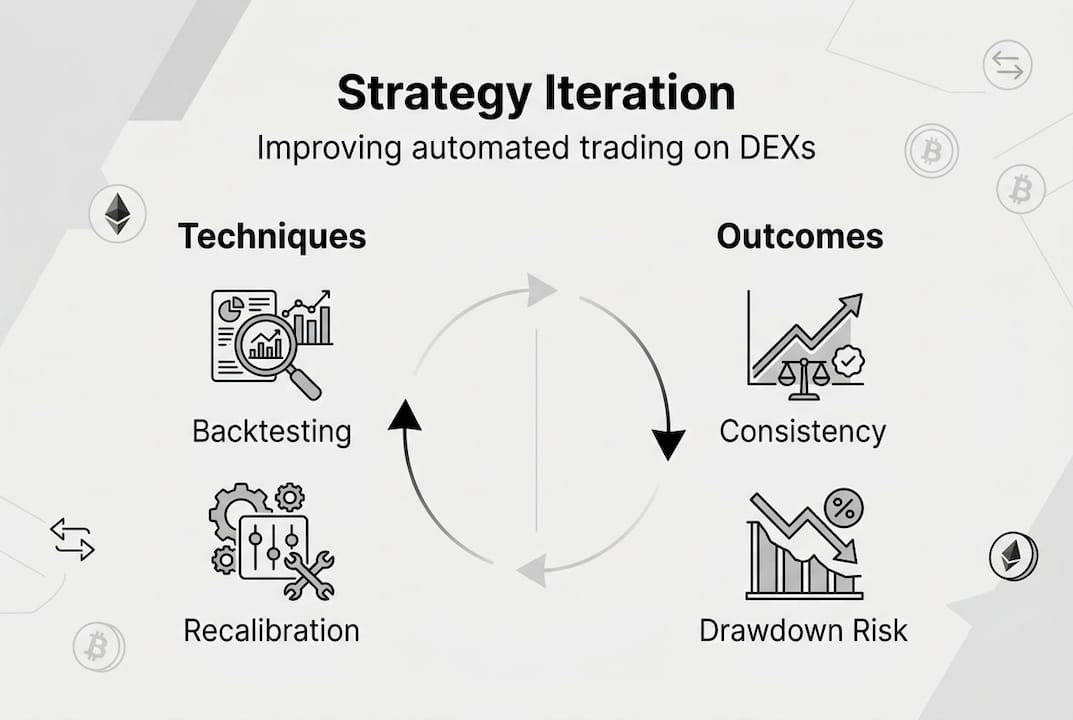
Many traders believe iterating on strategies is too complex or delivers marginal gains. That’s a costly misconception. Strategy iteration through backtesting and optimization enables rapid refinement of trading rules, reducing emotional decision making and revealing performance across market regimes like bull, bear, and sideways. Automated execution combined with iterative refinement transforms how you approach perpetual DEX trading in 2026. This guide unpacks evidence backed benefits and practical iteration methods that separate consistently profitable traders from those chasing losses.
Table of Contents
- How Strategy Iteration Improves Crypto Trading Outcomes
- Advanced Iteration Techniques: Walk-Forward Analysis And Dynamic Recalibration
- Balancing Complexity And Robustness: Pitfalls And Solutions In Strategy Iteration
- Applying Strategy Iteration For Effective Automated Execution On Perpetual DEXs
- Explore Mithril Money’s Automated Crypto Trading Solutions
Key takeaways
| Point | Details |
|---|---|
| Iterative backtesting reveals regime performance | Testing across bull, bear, and sideways markets uncovers strategy strengths and weaknesses |
| Dynamic strategies outperform static ones | Frequent re-optimization adapts to changing market conditions, delivering superior returns |
| Walk-forward analysis ensures robust gains | Rolling window testing prevents overfitting and validates out-of-sample performance |
| Overfitting risks demand validation methods | Parameter-free designs and cross-validation protect against false positives from rare events |
| Automated iteration reduces emotional bias | Data-driven refinement eliminates impulsive decisions and improves risk-adjusted returns |
How strategy iteration improves crypto trading outcomes
Backtesting and optimization reveal strengths and weaknesses of a strategy across different crypto market conditions. You test how your rules perform during bull runs, bear collapses, and choppy sideways action. This visibility lets you identify poor parameter choices before risking real capital.
Iterative refining reduces emotional trading mistakes by relying on data driven rules. When you’ve tested a strategy across hundreds of scenarios, you trust the system instead of second guessing every trade. Confidence comes from measurable performance metrics like Sharpe and Sortino ratios, not gut feelings.
You uncover hidden edge through repeated testing cycles. A strategy that looks mediocre with default settings might shine after tweaking entry thresholds or position sizing. Each iteration brings you closer to optimal configuration for current market dynamics.
Pro Tip: Run backtests on multiple timeframes simultaneously to spot inconsistencies. A strategy that works on 1-hour charts but fails on 15-minute data probably lacks robustness.
Consistent automated trading strategies emerge from this disciplined approach. You’re not guessing which parameters work. You’re proving them with historical data before deployment. The result is more confident, systematic execution that adapts as markets evolve.
Advanced iteration techniques: walk-forward analysis and dynamic recalibration
Walk-forward analysis simulates real-time re-optimization on rolling data windows. You optimize on a training period, test on the next unseen period, then roll forward and repeat. This prevents overfitting by forcing your strategy to perform on data it hasn’t seen during optimization.
Walk-forward analysis and dynamic recalibration, such as in regime-adaptive grid bots on SOL/USDC perps, allow monthly re-optimization, yielding +149% out-of-sample returns over 15 months with Sharpe 2.27 by adapting to bull/bear/vol regimes. That’s not theoretical performance. It’s validated on 17 months of unseen data.
Regime-adaptive grids dynamically adjust to different market conditions. During bull trends, the bot widens grid spacing and shifts reference prices upward. In volatile sideways action, it tightens spacing and adds rebound confirmation. Bear markets trigger defensive positioning with asymmetric grids favoring shorts.

Monthly recalibration maximizes returns and reduces drawdowns over long periods. Markets change. Volatility regimes shift. Static strategies decay as conditions evolve. Dynamic approaches maintain edge by continuously adapting parameters to current reality.
| Strategy Type | 15-Month Return | Sharpe Ratio | Max Drawdown |
|---|---|---|---|
| Static Grid | +47% | 0.89 | 18% |
| Regime-Adaptive Grid | +149% | 2.27 | 12% |
| Buy and Hold | +63% | 1.12 | 31% |
Practical tip: use walk-forward results to set realistic expectations for live trading. If your out-of-sample Sharpe is 1.5, don’t expect 3.0 in production. The gap between backtest and reality narrows when you validate properly.
Pro Tip: Split your data into at least 10 walk-forward windows. Fewer windows increase the chance of lucky results that don’t generalize to future markets.
This dynamic approach outperforms static strategies significantly because it respects market evolution. You’re not locked into parameters optimized for 2024 conditions. You’re adapting to what works in market regime analysis right now.
Balancing complexity and robustness: pitfalls and solutions in strategy iteration
Overfitting risks increase with rare event driven strategies. A liquidation cascade strategy might show 299% returns with Sharpe 3.58 in backtest, then collapse in live trading. Overfitting in rare events like liquidation cascades leads to out-of-sample failure despite high in-sample returns; beta decomposition reveals no significant alpha.
Comparing in-sample versus out-of-sample metrics reveals true strategy alpha. If your in-sample Sharpe is 2.8 but out-of-sample drops to 0.6, you’ve fit noise, not signal. The delta between these numbers tells you how much you’ve overfit.
Parameter-free and cross-validation techniques improve robustness against market anomalies. Instead of optimizing 15 parameters, design strategies with fixed rules based on market structure. When you must optimize, use k-fold cross-validation to ensure performance holds across different data subsets.
| Validation Method | Overfitting Risk | Implementation Complexity | Reliability Score |
|---|---|---|---|
| Single Backtest | High | Low | 3/10 |
| Walk-Forward Analysis | Medium | Medium | 7/10 |
| Cross-Validation + WFA | Low | High | 9/10 |
| Parameter-Free Design | Very Low | Medium | 8/10 |
Hybrid margin and liquidation risk management reduce cascade failures. Use cross-margin for correlated positions to improve capital efficiency, but isolate high-risk directional bets. This prevents one bad trade from triggering liquidations across your entire portfolio.
Implement dynamic margin thresholds to protect capital in volatile perpetual DEX markets. When realized volatility spikes above historical norms, automatically reduce position sizes and tighten stops. You maintain exposure while limiting tail risk.
Advanced traders layer multiple validation techniques. They start with parameter-free designs, add walk-forward analysis, then verify with cross-validation before risking capital. This multi-stage approach catches overfitting that single methods miss. The extra effort pays off in strategy automation and risk management that actually works when markets turn ugly.
Applying strategy iteration for effective automated execution on perpetual DEXs
Translating iteration principles into automated bot deployment requires systematic execution. Here’s how to implement iterative refinement on perpetual decentralized exchanges in 2026.
-
Start with minute-level backtesting to fine-tune grid parameters and risk controls. Perpetual DEXs show different microstructure than centralized exchanges. Slippage, funding rates, and liquidity depth vary by venue and time of day.
-
Use rebound confirmation and adaptive grid spacing to enhance dynamic grid bot effectiveness. Static grids place orders at fixed intervals. Dynamic grids adjust spacing based on recent volatility and shift reference prices after fills to capture trending moves.
-
Employ walk-forward re-optimization monthly for regime shifts. Markets don’t stay in one regime forever. Bull markets transition to sideways consolidation. Volatility compresses then explodes. Monthly recalibration keeps your parameters aligned with current conditions.
-
Structure automation with risk-aware settings like cross-margin and isolation hybrids. Cross-margin improves capital efficiency for delta-neutral strategies. Isolation protects against cascade liquidations for directional bets. Mix both approaches based on strategy correlation.
-
Review performance metrics continuously and recalibrate accordingly. Track realized Sharpe, Sortino, and maximum drawdown daily. When metrics deviate from backtest expectations by more than 20%, investigate whether market conditions changed or your strategy degraded.
Pro Tip: Keep a trading journal documenting every parameter change and the reasoning behind it. This creates an audit trail that reveals which iterations actually improved performance versus random tweaks.
Perpetual DEX automation demands venue-specific iteration. What works on one DEX might fail on another due to differences in funding mechanisms, liquidation engines, and order matching. Test your strategy on each venue separately, then deploy where edge is strongest. This multi-venue approach through delta neutral bots and other automated tools maximizes your opportunity set while managing platform-specific risks.
Explore Mithril Money’s automated crypto trading solutions
You’ve learned how iteration transforms trading outcomes through systematic refinement and validation. Now you need tools that make this process practical and scalable across perpetual DEXs.
Mithril Money offers automated crypto trading solutions that adapt to market regimes with iteration-friendly frameworks. The platform handles the technical complexity of backtesting, re-optimization, and risk management while you focus on strategy logic. Monthly recalibration features let you implement walk-forward analysis without custom coding. The points estimator tool quantifies strategy performance across different parameter sets, helping you identify optimal configurations faster. Delta neutral bots balance risk while capturing funding rate arbitrage, a strategy that benefits enormously from continuous iteration as funding dynamics shift.
FAQ
What is strategy iteration in crypto trading?
Strategy iteration means repeatedly backtesting and optimizing trading rules to improve performance over time. You test a strategy, analyze results, adjust parameters, then test again. This cycle reduces emotional decisions by relying on data driven refinement instead of gut feelings.
How does walk-forward analysis help avoid overfitting?
Walk-forward analysis tests strategy on rolling future periods after optimization, simulating live conditions. You optimize on historical data, validate on the next unseen period, then roll forward and repeat. It prevents fitting too closely to historical quirks, ensuring more reliable real-world results than single backtest approaches.
Can I automate strategy iteration on perpetual DEXs?
Yes, modern platforms offer bots that support automated backtesting, re-optimization, and dynamic market adaptation. Integration with perpetual DEXs enables seamless execution of freshly iterated strategies without manual intervention. Tools like Mithril handle the technical complexity of strategy automation on perpetual DEXs while you control the strategy logic and risk parameters.
What are common pitfalls in strategy iteration?
Overfitting to historical data can produce misleading results that fail in live trading. Rare events such as liquidation cascades distort performance evaluation by creating unrealistic profit expectations. Using cross-validation and parameter-free approaches can mitigate these risks by forcing strategies to work across multiple data subsets and market conditions.