

What Is Strategy Design for Perp DEX Automation

Every advanced American trader knows that the gap between theory and actual execution can drain performance fast. Strategy design in automated trading is what turns your market insight into a bot that acts intelligently instead of erratically. By converting your trading edge into a rule-based system, you minimize manual intervention and optimize speed, risk controls, and systematic process optimization. This guide clarifies core design principles and pitfalls so you can automate perpetual DEX strategies without technical headaches.
Table of Contents
- Defining Strategy Design In Automated Trading
- Key Types Of Strategies For Perp DEXs
- How Automated Strategy Execution Works
- Critical Risks And Optimization Considerations
Key Takeaways
| Point | Details |
|---|---|
| Importance of Strategy Design | A well-defined strategy design converts trading ideas into a systematic approach that operates without human oversight, optimizing for speed and accuracy. |
| Execution Quality Matters | The success of an automated trading strategy depends significantly on execution, requiring real-time monitoring and adaptability to market changes. |
| Balancing Rigidness and Complexity | Effective strategies must be flexible enough to adapt to market dynamics while being simple enough to execute efficiently. |
| Incorporating Safeguards | Systems must include controls like position limits and dynamic parameters to prevent catastrophic losses and manage risks effectively. |
Defining Strategy Design in Automated Trading
Strategy design is the blueprint for how your trading automation actually works. It’s the difference between a bot that randomly places orders and one that consistently captures real opportunities.
At its core, strategy design transforms your trading thesis into a rule-based system that can execute without human intervention. Instead of manually watching charts and placing trades, you codify your edge into logic that runs 24/7.
What Strategy Design Actually Does
Strategy design takes a market opportunity and breaks it into components the bot can execute:
- Identify the opportunity (funding arbitrage, momentum scalp, grid range, directional edge)
- Define entry and exit conditions (when to open, when to close, how to size)
- Set risk parameters (max loss per trade, position sizing, stop loss levels)
- Handle execution mechanics (order placement, refresh logic, hedge management)
Think of it like converting a trader’s instinct into pseudocode. If you’ve ever told someone “buy when price breaks above the 20-day high,” you’re already halfway to strategy design.

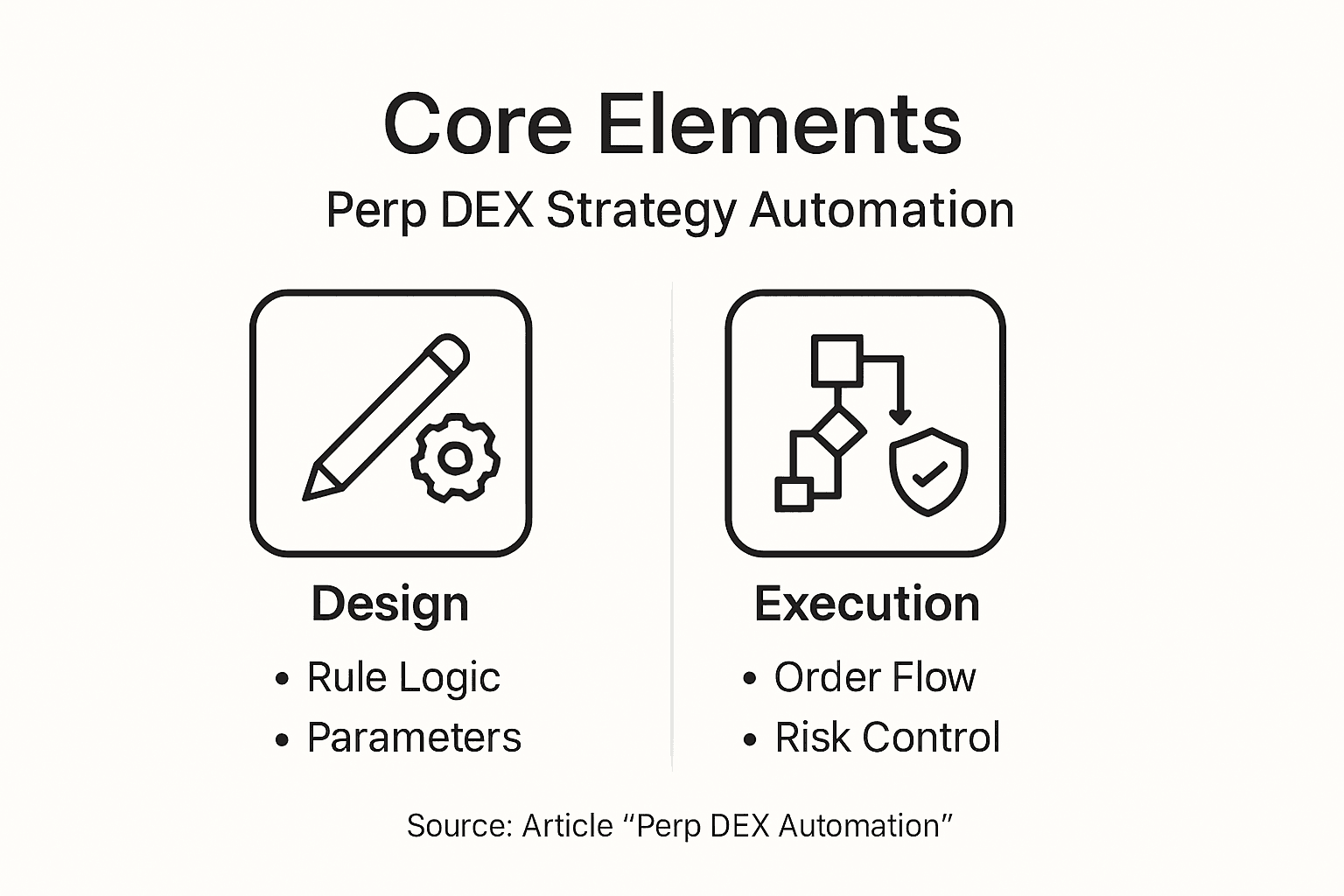
The Core Elements
Automated trading systems rely on predesigned programs that execute based on analytical models and real-time data. Your strategy design includes:
- Data inputs (price, funding rates, volume, order book depth)
- Analytical methods (moving averages, volatility measures, statistical arbitrage)
- Decision logic (if X happens, do Y; if not, do Z)
- Execution parameters (order size, timing, refresh intervals)
The goal is optimizing transaction speed and profitability while managing downside risk. This requires transforming technical and fundamental analysis into rules that a machine can follow instantly.
Why Design Matters
Poor strategy design kills automation. A bot with flawed logic will:
- Chase losses into deeper positions
- Over-leverage at exactly the wrong times
- Miss opportunities due to slow refresh rates
- Accumulate unnecessary slippage and fees
Good strategy design anticipates these failures and prevents them through systematic process optimization that includes data preprocessing, time-series analysis, and predictive modeling.
Your strategy design determines whether automation amplifies your edge or amplifies your mistakes.
The Design-Execution Loop
Strategy design isn’t a one-time event. Once your bot is live:
- Monitor performance against your thesis
- Identify what’s working and what’s not
- Adjust parameters or logic based on real results
- Redeploy and test again
Markets shift. Liquidity moves. Your design needs to adapt. This iteration cycle is where automation wins—you can test, adjust, and redeploy in minutes instead of hours.
Common Design Mistakes
Most traders new to automation design strategies that are too rigid or too complex:
- Too rigid — One market regime changes, the bot becomes useless
- Too complex — So many conditions that it never actually executes
- No risk controls — Unlimited position sizes or leverage exposure
- Ignoring venue differences — Assuming logic works the same on every DEX
Good design balances specificity (your edge) with flexibility (adapting to market shifts).
Pro tip: Start with one core thesis and nail the execution before adding complexity. A simple, well-designed bot that captures 20% of available opportunities beats a complicated one that captures nothing.
Key Types of Strategies for Perp DEXs
Perp DEXs aren’t all the same. Different venues have different mechanics, and that changes which strategies work where. Understanding the major strategy archetypes helps you pick the right setup for each market.
The strategies that print money on one DEX might barely break even on another. This is your real edge—knowing what works on which platform and why.
Delta-Neutral Arbitrage
Delta-neutral strategies exploit pricing differences between spot and perpetual markets, or between different perpetual venues. You’re long in one place, short in another, and pocketing the spread.
This works because:
- Funding rates vary across platforms
- Prices lag between venues
- Liquidity imbalances create temporary mispricings
- Execution timing creates fleeting opportunities
You don’t care if Bitcoin goes up or down. You only care about the spread closing. This is the safest automated strategy because your directional risk is nearly zero.
Funding Rate Arbitrage
When long positions are overcrowded on a perp DEX, the protocol charges funding to shorts. You can exploit this by being short at a high funding rate while holding spot elsewhere.
The math is simple: if funding is 0.5% per week, that’s 26% annualized. After fees and slippage, you still pocket a clean return with zero market risk.
Funding rate arbitrage is the closest thing to free money in perpetual DEXs—if you can execute it with minimal friction.
Market Making
Market making means providing liquidity and capturing the bid-ask spread. You post both buy and sell orders, collect small profits on each fill, and scale by being patient and consistent.
On AMM-style perpetuals, spreads are wider and more volatile. On CLOB perpetuals, you compete directly with other market makers. Automation matters here because:
- You can adjust spreads instantly as conditions change
- Inventory management happens in real time
- You never miss a profitable moment
- Consistent execution beats sporadic timing
Grid Trading
Grid trading places a series of orders above and below current price. As price bounces, you sell high and buy low within your grid. Rinse and repeat until price escapes the range.
It’s mechanical and rules-based. Perfect for automation. When volatility is moderate, grids print money. When volatility explodes, you get left holding bags at bad prices.
Momentum Scalping
Momentum scalping captures short-term directional moves. You identify acceleration, size in, and exit quickly. Rinse and repeat.
This requires:
- Real-time price feeds
- Fast execution
- Strict stop losses
- Position sizing discipline
Automation keeps emotions out and execution tight. Manual scalping gets sloppy when you’re tired or greedy.
Hybrid and Venue-Specific Strategies
The best traders don’t pick one strategy. They deploy different approaches on different venues based on what that venue does well.
Some strategies only work on hybrid models that combine AMM and CLOB mechanics, while others exploit pure liquidity pool designs or traditional order books.
Your edge comes from understanding these differences and deploying accordingly.
Pro tip: Test each strategy on the venue where it naturally fits. Funding arbitrage on a venue with flat funding rates will fail. Market making on illiquid AMMs will trap your inventory. Match the strategy to the venue’s actual mechanics.
Here’s a quick comparison of key automated trading strategy types for perpetual DEXs:
| Strategy Type | Market Conditions Suited For | Main Risk | Unique Business Advantage |
|---|---|---|---|
| Delta-Neutral Arbitrage | High spread, low volatility | Execution timing mismatch | Market-neutral, low drawdown |
| Funding Rate Arbitrage | Skewed funding environments | Sudden funding collapse | Passive yield, zero market bias |
| Market Making | Liquid, volatile markets | Inventory exposure | Consistent fee and spread capture |
| Grid Trading | Ranging, stable prices | Extreme breakouts | Profits from mean reversion moves |
| Momentum Scalping | Fast, directional moves | Slippage, false signals | Exploits rapid price momentum |
How Automated Strategy Execution Works
Automated execution is where your strategy idea becomes real trades. It’s the engine that turns logic into orders, monitors positions, and adjusts in real time without you staring at screens.
The difference between a good strategy and a profitable one often comes down to execution quality. Automation removes the human friction that kills returns.
The Core Execution Loop
Every automated strategy follows a repeating cycle:
- Monitor market conditions (price, funding, volume, spreads)
- Check if your entry conditions are met
- Place orders at the specified size and price
- Monitor the position
- Exit when your exit conditions trigger
- Return to step one
This loop runs constantly, 24/7, without fatigue or emotion. When conditions match your rules, execution happens instantly.
Real-Time Data Analysis
AI-driven decision support systems use continuous market analysis to dynamically adjust orders and positions. Your bot watches dozens of data points simultaneously and reacts instantly to changes.
This means:
- Funding rate spikes? Your bot adjusts position size.
- Spread widens? Your market maker adjusts quotes.
- Price moves against you? Your stop loss triggers automatically.
- Liquidity appears? Your bot sizes in immediately.
No human can react this fast. That’s the edge.
Order Management and Risk Control
Digitized workflows guide every order placement and adjustment. Your bot follows preprogrammed instructions exactly.
This includes:
- Placing orders at exact prices and sizes
- Refreshing orders when market conditions change
- Canceling orders that no longer make sense
- Submitting new orders as opportunities appear
- Monitoring fills and adjusting hedges
Automated execution eliminates slippage from slow thinking. Your bot makes decisions at machine speed.
Continuous Monitoring and Adaptation
The bot doesn’t just execute once and disappear. It continuously monitors performance against your thesis. If conditions change, it adapts.
Intelligent automation facilitates real-time adjustment of orders and positions as market dynamics shift. Your strategy can evolve without manual intervention.
If funding rates collapse, the bot recognizes the opportunity is gone and adjusts. If a new liquidity window opens, it sizes in. If volatility spikes, it may increase or decrease exposure based on your rules.
Non-Custodial Execution
Your bot has API access to your exchange account, but never controls your funds. All trades execute on your actual account. You maintain full custody and control.
This matters because:
- You can pause or kill the bot anytime
- You can manually override positions
- No third party holds your capital
- You see every trade in real time
Risk Management Built In
Good automated execution includes safeguards that prevent catastrophic losses:
- Position size limits (never exceed X notional)
- Loss limits (stop if drawdown hits Y)
- Leverage caps (never exceed Z leverage)
- Refresh timeouts (kill orders that don’t fill quickly)
- Circuit breakers (pause on extreme volatility)
These aren’t optional. They’re what separate profitable automation from account-destroying robots.
Pro tip: Start with smaller position sizes and tighter risk limits. Once your bot proves it executes reliably for two weeks, gradually increase size. A bot that works at 10% size but breaks at 100% size is worse than useless.
Critical Risks and Optimization Considerations
Automation amplifies both wins and losses. A profitable strategy executed perfectly prints money. A flawed strategy executed at machine speed burns capital fast. This section covers the real dangers and how to avoid them.
The traders who survive automation are the ones who respect its power and build safeguards into their systems.
Runaway Position Accumulation
One of the most dangerous scenarios happens when orders fill faster than expected. Your bot intended to size in gradually but suddenly finds itself massively over-leveraged.
This happens because:
- Multiple orders fill simultaneously
- Network latency delays position updates
- Market gaps create unexpected fills
- Your bot doesn’t know its true position size
Result: a position 10x larger than intended, taking 10x the losses when the market moves against you.
Excessive Order Placement
Robust pre-trade controls are non-negotiable. Without them, your bot can place hundreds of orders per second during volatile conditions.
Implement hard limits on:
- Maximum orders per second
- Maximum order size
- Maximum notional exposure
- Maximum leverage ratios
- Price deviation thresholds
These aren’t restrictions. They’re survival mechanisms.
Parameter Overfitting
You backtest your strategy on historical data and find parameters that worked perfectly. You deploy them live and immediately lose money. Why?
Your parameters were optimized for the past, not the future. Market regimes change. What worked during a bull market fails during consolidation.
Backtested perfection is usually a red flag that you’ve overfitted to noise, not signal.
Kill-Switches and Halts
Automated trading systems require kill-switches that halt trading on anomalies. Without them, a single bug can spiral into catastrophic losses.
Your bot should stop immediately if:
- Drawdown exceeds your limit
- Price moves more than X% in Y seconds
- Volatility spikes beyond normal ranges
- Order fills at prices wildly different from expected
- Your position diverges from intended size
A good kill-switch stops losses in seconds. A missing one costs you thousands.
Optimization Through Backtesting
Proper optimization isn’t about finding the best parameters for past data. It’s about refining entry and exit points while adapting to changing market conditions.
The right approach:
- Test on historical data (but expect worse in production)
- Paper trade with your parameters for two weeks
- Compare paper results to backtest results
- If they diverge, your strategy is overfitted
- Simplify and retest
- Deploy only when live results match expectations
Dynamic Parameter Adjustment
Good systems don’t use static parameters. They adjust based on market conditions.
Your market maker should widen spreads during high volatility, not narrow them. Your grid trader should shrink grid sizes when price is trending, not when it’s ranging. Your position sizer should scale exposure based on realized volatility, not fixed notional amounts.
This requires algorithmic adjustments that monitor live conditions and adapt in real time.
Exchange-Level Coordination
Different exchanges have different rules and circuit breakers. Your bot needs to respect those limits or face forced liquidations and blacklisting.
Understand each venue’s rules on:
- Maximum order size
- Maximum orders per second
- Permitted leverage
- Volatility halts
- Maintenance requirements
Ignoring these turns your bot into a liability.
Pro tip: Build in a “slow mode” for your bot where it operates at 10% normal speed and posts smaller orders. Use slow mode for the first week after deploying to any exchange. Once you confirm the bot behaves as expected, gradually increase speed and size.
The following table summarizes critical process controls for safe automation:
| Control Mechanism | Purpose | Example Implementation |
|---|---|---|
| Position Limits | Prevents over-leveraging | Max notional size per position |
| Pre-Trade Checks | Stops erroneous orders | Price deviation and size checks |
| Kill-Switch | Halts trading on anomalies | Trigger on sudden drawdown |
| Dynamic Parameters | Adapts to market changes | Adjust spread during volatility |
Bridge Your Strategy Design to Real Automated Execution with Mithril
The challenge of transforming a complex perp DEX strategy into consistent and risk-managed automation can feel overwhelming. You want to capture opportunities like delta-neutral arbitrage or funding rate plays without the pain of managing order placement, risk controls, and manual iteration. The article highlights how strategy design is the blueprint for automated success yet navigating venue differences, execution speed, and risk safeguards often breaks traders new to automation.
Mithril solves these problems by acting as your strategy execution partner, built around the Opportunity → Execution → Iteration loop. Leveraging AI-assisted analysis across multiple strategies such as market making, grid trading, and momentum scalping, Mithril discovers alpha where it exists and automates your ideas into live, non-custodial execution on perp DEXs. With built-in risk controls and kill-switches, your bot adapts to shifting markets avoiding common pitfalls like runaway positions or over-ordering.
Take control of your strategy design and trust Mithril to execute flawlessly. Explore how Mithril turns trading ideas into automated performance to reduce cognitive overhead and increase your edge. Discover automated perp DEX execution today and experience the power of seamless iteration and optimization in a platform made for serious traders.
Ready to elevate your perp DEX automation with strategy-driven execution that adapts in real time? Visit Mithril now and start turning your strategy designs into live, controlled bots that deliver consistent results.
Frequently Asked Questions
What is strategy design in automated trading?
Strategy design in automated trading is the process of transforming a trader’s market thesis into a rule-based system that can execute trades automatically without human intervention. It outlines how a trading bot should identify opportunities, set entry and exit conditions, define risk parameters, and handle execution mechanics.
Why is strategy design important for automated trading?
Good strategy design is crucial because it determines whether your automation amplifies your trading edge or leads to substantial losses. Flawed strategy design can cause issues like over-leveraging or missing trading opportunities, while robust design helps optimize transaction speed and profitability.
What are the common mistakes in strategy design?
Common mistakes in strategy design include creating strategies that are too rigid or too complex, failing to implement risk controls, and ignoring differences between trading venues. A balance between specificity and flexibility is necessary for a successful automated trading strategy.
How does automated strategy execution work?
Automated strategy execution involves a continuous cycle where the system monitors market conditions, checks entry triggers, places orders, monitors positions, and exits when conditions are met. This process operates 24/7 without fatigue or emotions, providing an edge in trade execution.