

Strategy automation on perpetual DEXs: execution & risk 2026

Perpetual DEX trading has evolved beyond simple grid strategies. Today’s most profitable traders leverage signal-first automation that combines AI decision-making with advanced risk controls, capturing opportunities traditional methods miss. As perpetual DEXs capture 26% of futures volume, execution quality and risk management separate winners from losers. This guide reveals how experienced traders enhance performance using automated tools without building infrastructure, from signal-first architecture to stealth execution and capital protection techniques that work in real market conditions.
Table of Contents
- Understanding Strategy Automation On Perpetual DEXs
- The Signal-First Model: A Game Changer In Strategy Automation
- Leveraging Advanced Perpetual DEX Features For Effective Automation
- Best Practices For Execution Quality And Risk Management In Automated Trading
- Enhance Your Trading With Mithril Money’s Automated Tools
- Frequently Asked Questions
Key takeaways
| Point | Details |
|---|---|
| Signal-first beats grid-first | AI-powered signals optimize entries and protect capital better than static grid orders |
| DEX automation without coding | Modern platforms offer plug-and-play bots with advanced order types and API access |
| Backtesting prevents losses | Rigorous validation with historical data identifies flaws before risking real capital |
| Stealth execution matters | Hidden orders and trailing stops reduce MEV exposure and slippage on DEXs |
| Risk controls are essential | Dynamic position limits and smart stop-loss orders safeguard against adverse moves |
Understanding strategy automation on perpetual DEXs
Perpetual decentralized exchanges now command serious market share. Perpetual DEXs capture around 26% of global crypto futures volume, proving these platforms handle institutional-grade liquidity. Automated strategies offer ways to navigate volatility and scale execution without manual intervention. You can capture funding rate arbitrage at 3 AM or exit positions during flash crashes without staring at screens.
Traders face distinctive challenges in execution quality, latency, and risk management on decentralized platforms. Unlike centralized exchanges, DEXs introduce blockchain confirmation times, gas fee variability, and MEV risks that complicate automation. Building custom automation infrastructure demands engineering resources most traders lack. You need API integration, order management logic, risk controls, monitoring systems, and constant maintenance.
Modern tools and bots reduce barriers by offering plug-and-play automation connected to market signals. Platforms now provide sophisticated automated trading strategies and DeFi tools that handle infrastructure complexity behind the scenes. You focus on strategy logic while the platform manages execution, position monitoring, and risk safeguards. This democratization lets experienced traders compete with well-funded teams.
Key automation capabilities include:
- Real-time signal processing from AI indicators and technical analysis
- Dynamic position sizing based on volatility and account equity
- Advanced order types like hidden orders and trailing stops
- Automated rebalancing for delta-neutral and market-making strategies
- Integration with popular charting platforms for alert-based execution
The infrastructure challenge explains why many profitable manual traders struggle with automation. Execution quality suffers when homegrown systems lack robust error handling or market regime adaptation. Professional-grade automation requires constant iteration, something resource-constrained traders cannot sustain alone.
The signal-first model: A game changer in strategy automation
The AURA Signal Bot employs a signal-first architecture powered by AI indicators and algorithmic decision-making, dynamically optimizing entries and managing exposure. This approach fundamentally differs from traditional grid-first models that rely on predefined price intervals. Signal-first bots analyze market conditions in real time, adjusting position sizes and entry timing based on probability-weighted outcomes rather than mechanical rules.
Grid-first models place orders at consistent intervals across a price range, capturing volatility through mean reversion. They work well in ranging markets but suffer during trends, accumulating losing positions as price moves directionally. You end up with maximum exposure at the worst possible time. Grid strategies also ignore market context, treating all price levels equally regardless of support, resistance, or momentum signals.
Signal-first allows complex internal computations optimizing capital allocation and reducing open positions. The Signal-First model offers more complex internal calculations, better entry optimization, fewer open positions, and better capital protection compared to the Grid-First model. Instead of spreading capital across dozens of grid levels, signal-first concentrates positions where probability favors profitable outcomes. This concentration improves capital efficiency and reduces exposure to adverse price moves.
Pro Tip: Focus on bots supporting signal-first architecture to leverage smarter, adaptive execution techniques that respond to changing market regimes rather than fighting them.
The execution precision advantage becomes clear in volatile markets. When Bitcoin drops 15% in an hour, grid-first systems accumulate maximum long exposure near the bottom of the range. Signal-first systems recognize weakening momentum and reduce position sizes or exit entirely, preserving capital for better opportunities. This dynamic risk management separates sustainable strategies from those that blow up during extreme moves.
| Feature | Grid-First Model | Signal-First Model |
|---|---|---|
| Entry Logic | Fixed price intervals | AI-driven probability analysis |
| Capital Allocation | Spread evenly across range | Concentrated at high-probability levels |
| Market Adaptation | Static, predefined rules | Dynamic adjustment to conditions |
| Position Count | Many simultaneous orders | Fewer, optimized positions |
| Risk Management | Manual stop-loss only | Integrated exposure control |
The shift from traditional grid strategies reflects broader algorithmic trading evolution. Successful automation now requires AI-driven entry optimization that processes multiple data streams, from order flow imbalances to funding rate changes, synthesizing signals into actionable position adjustments. You gain edge through superior information processing, not just faster execution.
Leveraging advanced perpetual DEX features for effective automation
High-frequency and automated strategies benefit from low-latency APIs and advanced order types that centralized exchanges pioneered. Aster DEX offers automated grid trading, high-speed API access, and advanced order types on its Central Limit Orderbook (CLOB), bringing institutional-grade tools to decentralized trading. You can execute complex multi-leg strategies with millisecond precision, competing with professional market makers.

Stealth execution orders improve MEV protection and limit exposure risks that plague public DEX transactions. Hidden orders keep your intentions private, preventing front-running by searchers monitoring the mempool. Trailing stops automatically adjust exit levels as price moves favorably, locking in profits without constant manual intervention. These tools matter when trading size, where visible orders invite predatory behavior from sophisticated actors.
No-code integration with popular charting tools like TradingView democratizes automation setup for traders without programming skills. Integration of TradingView alerts with Aster DEX allows trade execution based on charting signals without coding, connecting your technical analysis directly to live positions. You draw trendlines, set RSI thresholds, or configure custom indicators, then let the platform execute trades when conditions trigger.
Pro Tip: Regularly backtest and validate strategies before live deployment to avoid costly mistakes that wipe out months of gains in minutes.
Steps to employ these features for effective automation:
- Connect API credentials to your chosen perpetual DEX, ensuring proper permissions for order placement and position management while restricting withdrawal access for security.
- Configure advanced order types including hidden orders for stealth entry, trailing stops for dynamic exits, and conditional orders that trigger based on price or time criteria.
- Link signal alerts from your charting platform or AI indicators, mapping specific technical setups to automated position entries with predefined size and risk parameters.
- Monitor execution quality metrics including fill rates, slippage, and revert rates, adjusting parameters when performance degrades below acceptable thresholds.
The Aster DEX capabilities and APIs extend beyond basic order placement. You can query real-time funding rates across perpetual contracts, monitor open interest changes signaling positioning shifts, and access historical tick data for strategy refinement. This data infrastructure supports sophisticated strategies like statistical arbitrage and volatility harvesting that require granular market information.
Advanced traders combine multiple features into cohesive systems. A delta-neutral funding strategy might use hidden orders to accumulate positions without moving the market, trailing stops to protect against basis risk, and TradingView alerts to adjust hedge ratios when correlation breaks down. Each component handles a specific execution or risk management function, creating robust automation that adapts to market conditions.
Best practices for execution quality and risk management in automated trading
Backtesting with historical data is critical to verify strategy logic before using real capital. Automated trading strategies require rigorous validation through Backtesting, simulating how your rules would have performed across different market regimes. You discover hidden assumptions that fail during high volatility or low liquidity. A strategy profitable in 2025’s bull market might hemorrhage money during 2026’s consolidation.
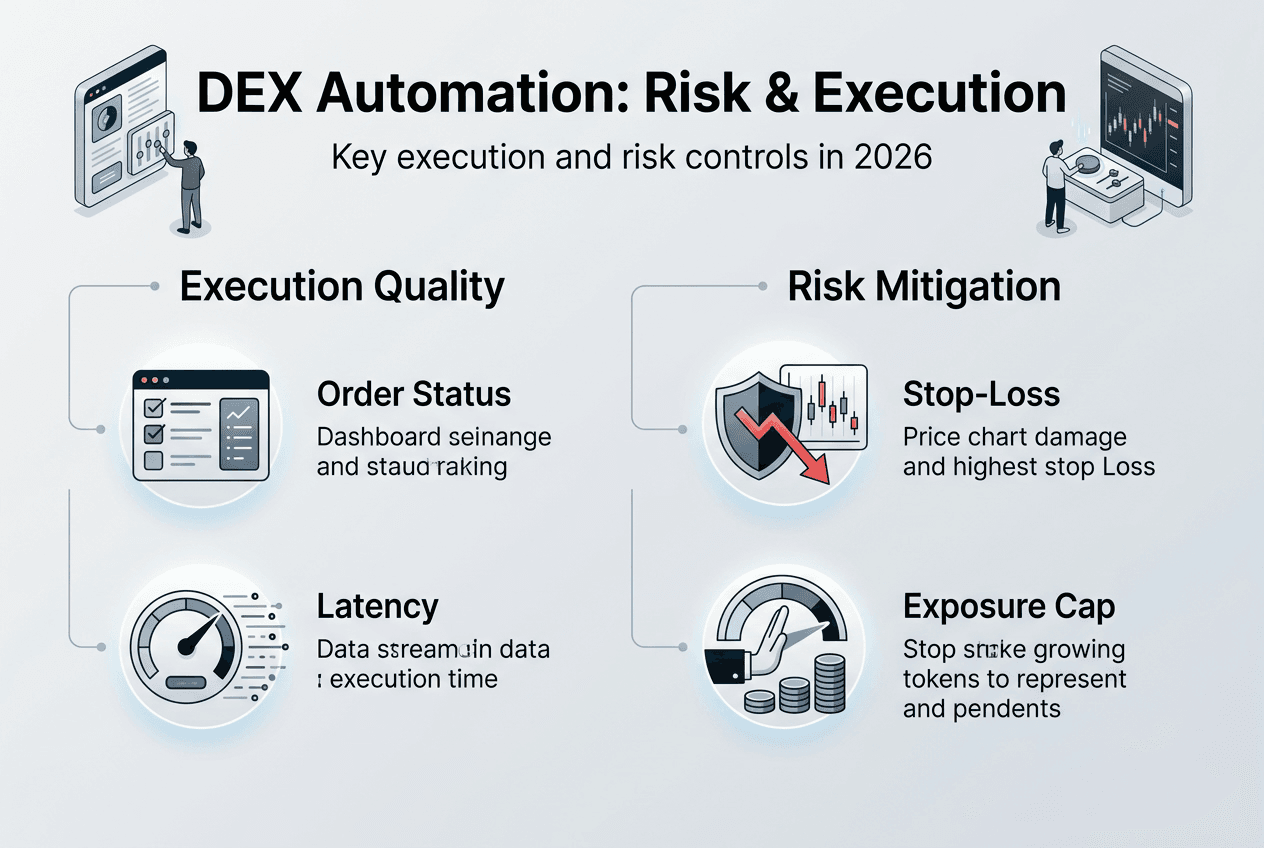
Monitoring order status and handling reverted transactions helps reduce slippage and increased fees from failures that plague blockchain-based trading. Revert rates on rollups rose to over 10% after the Dencun upgrade, with swaps responsible for most reverts. When your order reverts, you miss the intended entry price and pay gas fees for nothing. Robust automation includes retry logic with adjusted parameters and alerts when revert rates spike.
| Risk Category | Common Issues | Mitigation Strategies |
|---|---|---|
| Code Bugs | Logic errors causing unintended positions | Extensive testing, gradual capital deployment |
| Market Volatility | Slippage exceeding acceptable thresholds | Dynamic position sizing, volatility-adjusted limits |
| Transaction Reverts | Failed orders during network congestion | Gas price optimization, retry logic, revert monitoring |
| Liquidity Gaps | Unable to exit positions at target prices | Depth analysis before entry, staged exits |
| MEV Exploitation | Front-running and sandwich attacks | Stealth orders, private transaction submission |
Capital protection techniques include limiting open positions, dynamic exposure management, and using smart stop-loss orders that adapt to market conditions. You might risk 2% per trade during normal volatility but reduce to 0.5% when realized volatility doubles. Position limits prevent concentration risk, ensuring no single trade or correlated group of trades can cause catastrophic losses.
Pro Tip: Employ tools with real-time alerts and fail-safes to promptly manage exceptions and market shifts that automated systems cannot handle alone.
Dynamic exposure management adjusts total portfolio risk based on performance and market regime. After a string of losses, you reduce position sizes to preserve capital and rebuild confidence. During favorable conditions with strong win rates, you gradually increase exposure to compound gains. This adaptive approach beats static risk parameters that ignore changing circumstances.
Smart stop-loss orders go beyond simple price triggers. Volatility-adjusted stops widen during normal fluctuations to avoid premature exits while tightening during unusual moves signaling genuine reversals. Time-based stops exit positions that fail to move favorably within expected timeframes, freeing capital for better opportunities. Correlation-based stops monitor hedge effectiveness, closing both legs when the relationship breaks down.
The validating automated strategies process includes forward testing with small capital after backtesting shows promise. You run the strategy live for weeks or months with minimal size, observing execution quality, slippage, and psychological comfort with the approach. Many strategies that look perfect in backtests fail forward testing due to overfitting or market microstructure realities the simulation missed.
Enhance your trading with Mithril Money’s automated tools
Executing sophisticated strategies on perpetual DEXs no longer requires building infrastructure from scratch. Mithril Money automated trading strategies and DeFi tools offer plug-and-play solutions tailored for experienced traders seeking execution quality without engineering overhead. Their platform supports signal-first bots, advanced risk controls, and non-custodial execution that keeps your funds secure on the exchange.
You can utilize the Mithril Bots points estimator to measure your strategy’s potential returns and risk metrics before committing capital. The comprehensive Mithril Bots automation guide walks through setup, optimization, and monitoring best practices. Joining Mithril streamlines your pathway to enhanced execution quality, letting you focus on strategy refinement rather than infrastructure maintenance.
Frequently asked questions
What is strategy automation on perpetual DEXs?
Strategy automation executes predefined trading rules on perpetual DEX platforms without manual intervention, handling entries, exits, and position management based on signals or algorithms. It combines exchange APIs, risk controls, and decision logic into systems that operate continuously.
How does signal-first architecture improve trading results?
Signal-first architecture uses AI and probability analysis to optimize entry timing and position sizing, concentrating capital where odds favor profitable outcomes. This approach reduces unnecessary positions and protects capital better than grid-first models that ignore market context.
What risks should I monitor when automating DEX strategies?
Monitor transaction revert rates, slippage versus expectations, position concentration, correlation breakdown in hedged strategies, and execution latency during volatile periods. High revert rates or excessive slippage indicate infrastructure problems requiring immediate attention.
Can I automate trading without programming skills?
Yes, modern platforms offer no-code integration with charting tools like TradingView, letting you execute trades based on technical indicators and alerts without writing code. You configure rules through visual interfaces that connect signals to automated position management.
Why is backtesting essential before live deployment?
Backtesting reveals how your strategy performs across different market conditions, exposing flaws and overfitting before risking real capital. Strategies that look profitable in one regime often fail in others, and backtesting identifies these weaknesses through historical simulation.