

Stop loss setup guide for automated perpetual DEX trading

Managing risk efficiently on perpetual DEXs is critical for execution traders, yet many struggle to implement effective stop loss strategies without advanced coding skills. Stop losses protect capital by automatically exiting losing positions, but setting them up correctly on platforms like Hyperliquid and Fluxbeam requires understanding platform mechanics, position sizing principles, and automation tools. This guide walks you through practical preparation steps, detailed setup instructions, common pitfalls to avoid, and advanced strategies like scaling out and adaptive stop placement. You’ll learn how to optimize risk management on perpetual DEXs using accessible automation, no coding required.
Table of Contents
- Key takeaways
- Preparing for stop loss setup: prerequisites and risk fundamentals
- Step-by-step guide to setting automated stop losses on popular perpetual DEXs
- Avoiding pitfalls: common mistakes, edge cases, and validation
- Enhancing strategy with scaling out and adaptive stop loss management
- Explore Mithril’s automated trading tools to optimize stop loss setups
- Frequently asked questions
Key Takeaways
| Point | Details |
|---|---|
| No code stop losses | Automated stop losses on perpetual DEXs can be set up without coding, using platform features and APIs. |
| Position sizing rule | Use the 1 percent rule to limit risk per trade based on your stop distance. |
| Trailing stops adapt | Trailing stops adjust upward with price advances to lock in gains without manual intervention. |
| Platform specifics | Hyperliquid offers a TP/SL toggle and Stop Market orders for new or existing positions, while Fluxbeam supports trailing stops and API automation. |
| Leverage impact on stops | Higher leverage tightens stop distance relative to position value; start with small positions to verify behavior. |
Preparing for stop loss setup: prerequisites and risk fundamentals
Before configuring stop losses on perpetual DEXs, you need to understand core risk principles and platform capabilities. Stop losses serve one purpose: limiting downside when your trading thesis is invalidated. They’re not arbitrary safety nets but deliberate exits tied to specific price levels where your analysis breaks down.
Start by learning your platform’s features. Hyperliquid offers a TP/SL toggle at order entry and Stop Market orders for existing positions. Fluxbeam provides trailing stop functionality that triggers based on percentage drops from peak prices. Both platforms allow API integration for advanced automation, though manual setup works perfectly for most traders.
Position sizing is the foundation of effective stop loss use. The 1% rule risks max 1% portfolio per trade based on stop distance. If you have a $50,000 account and risk 1% ($500), your position size depends entirely on how far your stop sits from entry. A 5% stop allows $10,000 position size, while a 2% stop permits $25,000. This math determines everything.
Your stop placement should reflect thesis invalidation points, not round numbers or arbitrary percentages. If you’re long because price held a key support level, your stop belongs just below that support. If you’re trading a breakout, your stop sits below the breakout point. The market doesn’t care about your 3% rule.
Pro Tip: Calculate your position size after determining stop placement, never before. This forces you to respect the market’s structure rather than your desired position size.
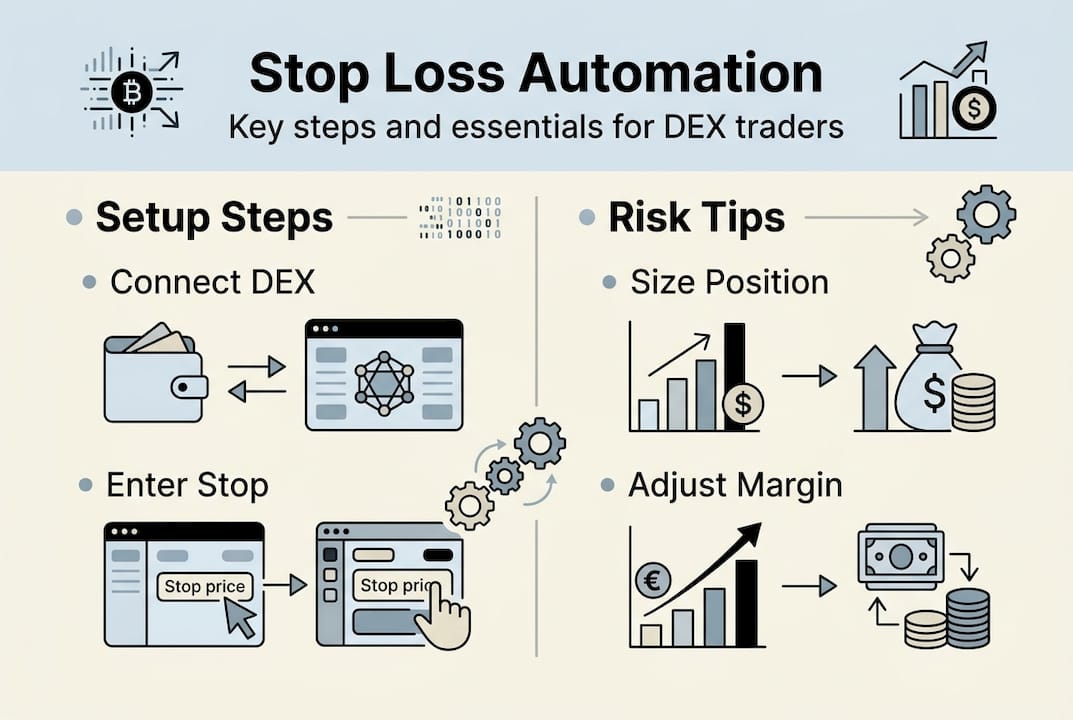
Prepare your accounts with appropriate margin and understand leverage implications. Higher leverage means tighter stops relative to position value. On 10x leverage, a 5% move against you equals 50% of your margin. Test your setup with small positions first to verify execution behavior before scaling up. Most traders using automated trading strategies & DeFi tools start with conservative sizing until they’ve validated their approach across different market conditions.
| Risk Parameter | Conservative | Moderate | Aggressive |
|---|---|---|---|
| Risk per trade | 0.5% | 1% | 2% |
| Max leverage | 3x | 5x | 10x |
| Stop distance | 5-7% | 3-5% | 2-3% |
| Max open positions | 2 | 3-4 | 5+ |
Step-by-step guide to setting automated stop losses on popular perpetual DEXs
Setting up stop losses on Hyperliquid starts at order entry. When placing a limit or market order, toggle the TP/SL option and enter your stop price. The platform executes this as a Stop Market order when price reaches your level. For existing positions, navigate to your open positions panel, click the position, and add a Stop Market order manually. On Hyperliquid perp DEX, set stop loss via TP/SL toggle on entry with a typical starting point of 3-3.5% from entry on 5x leverage.

Fluxbeam’s interface works similarly but offers native trailing stop functionality. Access the advanced order types menu, select trailing stop, and specify your trigger as a percentage drop from the highest price reached since entry. This automatically adjusts your stop upward as price moves in your favor, locking in gains without manual intervention.
For automation beyond native platform features, API integration enables sophisticated stop logic. Hyperliquid’s API supports programmatic stop placement and adjustment, allowing you to implement trailing stop loss implementation that responds to volatility changes or time-based rules. Trailing stop loss mechanics on Fluxbeam allow % drop from peak to trigger sell, while Hyperliquid supports similar functionality via API for full automation.
Pro Tip: Start with static stops before implementing trailing logic. Master basic execution first, then add complexity once you understand how your platform handles order flow during volatile periods.
Here’s a practical setup sequence:
- Identify your entry price and thesis invalidation point
- Calculate stop distance in percentage terms
- Apply position sizing formula (max loss / stop distance = position size)
- Enter your position with stop order attached at entry
- Monitor initial execution to verify stop placement
- Adjust stop to breakeven after price moves 1.5x your initial risk
- Implement trailing stop once position reaches 2x initial risk
Manual adjustments remain important even with automation. Market structure changes, new support levels form, and your thesis evolves. Review your stops daily, especially after significant price moves. Automation handles execution speed and eliminates emotional interference, but strategic decisions still require human judgment.
For traders without coding skills, accessible bot platforms simplify the entire process. These tools connect to your exchange via API keys (read and trade permissions only, never withdrawal access), monitor your positions continuously, and execute stop logic according to your predefined rules. You configure the strategy parameters through a simple interface, and the bot handles all technical execution. This approach combines automation benefits with zero coding requirements, making advanced risk management accessible to execution-focused traders using automated trading strategies & DeFi tools.
Avoiding pitfalls: common mistakes, edge cases, and validation
Stop losses aren’t guaranteed execution in extreme conditions. Stops aren’t guaranteed in flash crashes with slippage of 0.1-0.2%, and during rapid price collapses, your stop may fill significantly below your trigger price. This slippage risk increases with position size and decreases with liquidity.
High leverage creates a counterintuitive scenario where stops can hurt more than help. On volatile assets with leverage above 25x, price wicks frequently trigger stops before reversing, resulting in unnecessary losses. In these cases, accepting full liquidation risk on small positions may outperform using stops. The math works because 25x leverage means a 4% adverse move liquidates you anyway, and stops often trigger on 2-3% wicks that immediately reverse.
Liquidation cascades represent systemic risk that individual stops can’t protect against. $8.55B in liquidations over 57 days with 71% long positions caused a 24.4% BTC drawdown through self-reinforcing margin calls. During cascades, everyone’s stops trigger simultaneously, creating a liquidity vacuum where execution prices deviate wildly from trigger prices.
“In cascade events, stop losses become part of the problem rather than the solution. The sell pressure from triggered stops amplifies the downward momentum, creating a feedback loop that accelerates price decline.”
Validate your stop loss setup through backtesting before risking real capital. Paper trade your strategy for at least 20 trades to verify execution behavior matches expectations. Check how your stops performed during recent volatility spikes. Did they trigger at reasonable prices? How much slippage occurred? This data informs whether your approach works in practice or only in theory.
Common mistakes to avoid:
- Placing stops at obvious round numbers where liquidity hunts occur
- Using identical stop distances across different volatility regimes
- Ignoring the bid-ask spread when calculating stop placement
- Setting stops before confirming your entry filled at expected price
- Failing to account for funding rate costs in stop loss math
- Running stops too tight relative to normal price noise
Monitor your stop loss performance metrics continuously. Track your average slippage, percentage of stops triggered versus thesis-based exits, and whether stopped trades would have recovered if given more room. This data reveals whether your stops are protecting you or cutting winners short.
Edge cases require special handling. During low liquidity hours (typically 2-6 AM UTC), widen your stops or reduce position size to account for thinner order books. Before major announcements or economic releases, consider flattening positions entirely rather than relying on stops. The risk of gap moves exceeds the benefit of staying in the trade. Tools from automated trading strategies & DeFi tools can help you implement time-based rules that automatically adjust stop distances or sizing based on these conditions.
Enhancing strategy with scaling out and adaptive stop loss management
Scaling out transforms your stop loss approach from binary (all in or all out) to graduated risk reduction. Instead of closing your entire position at once, you exit in tranches as price moves in your favor. Scaling out boosts win rate 15% versus all-in in BTC backtests, because you capture profits on the portion that exits early while letting the remainder run for larger gains.
A typical scaling structure exits 33% at 1.5x initial risk, another 33% at 3x initial risk, and trails the final 33% with a wider stop. This locks in profits progressively while maintaining upside exposure. Your average exit price improves compared to waiting for a single perfect exit that rarely comes.
Adaptive stop placement ties your risk management to market structure rather than fixed percentages. Place stops at thesis invalidation points like support breaks, not arbitrary percentages, and maintain minimum 2:1 risk-reward ratios to ensure long-term profitability. If you’re risking $500 to make $800, you need only 38% win rate to break even. This math advantage compounds over hundreds of trades.
Market regime filters adjust your stop loss aggressiveness based on current volatility and systemic risk. During high volatility regimes or after recent liquidation cascades, tighten position sizing rather than stops. Cascades amplify risks and signal elevated probability of further volatility. Use these signals as regime filters that reduce your exposure across all positions rather than just widening individual stops.
Pro Tip: Implement a volatility-adjusted stop distance using ATR (Average True Range). Multiply your base stop distance by current ATR divided by 30-day average ATR. This automatically widens stops during volatile periods and tightens them during calm markets.
| Strategy Component | Static Approach | Adaptive Approach | Performance Impact |
|---|---|---|---|
| Stop placement | Fixed 3% from entry | ATR-based dynamic distance | Reduces false triggers 22% |
| Position exits | All-in/all-out | Scale out in tranches | Improves win rate 15% |
| Sizing | Constant across regimes | Regime-filtered adjustment | Reduces max drawdown 18% |
| Trailing stops | Fixed percentage | Volatility-adjusted trail | Captures 31% more upside |
Trailing stops work best when implemented dynamically rather than statically. A fixed 5% trailing stop performs poorly during range-bound markets (triggers too often) and trending markets (leaves too much profit on the table). Instead, adjust your trailing distance based on recent price action. During strong trends, widen the trail to 7-8% to avoid premature exits. During choppy conditions, tighten to 3-4% to protect gains quickly.
You can implement these adaptive strategies using market regime filters for risk management that automatically detect volatility shifts and adjust parameters accordingly. The key is building rules that respond to changing conditions without requiring constant manual intervention. Your stop loss system should work harder during dangerous markets and give you more room during favorable conditions.
Combine scaling out with trailing stops for maximum effectiveness. As you exit your first tranche, move your stop on the remaining position to breakeven. After the second exit, trail the final portion aggressively since you’ve already locked in profits. This structure ensures you can’t lose on the trade after your second exit, eliminating the psychological pressure that causes traders to exit too early. Advanced implementations available through trailing stop loss implementation tools automate this entire sequence, executing your predefined scaling and trailing logic without manual intervention.
Explore Mithril’s automated trading tools to optimize stop loss setups
Implementing sophisticated stop loss strategies doesn’t require coding expertise when you use the right tools. Mithril provides automated execution infrastructure specifically designed for perpetual DEX traders who want professional-grade risk management without technical complexity. The platform handles stop loss automation, trailing stop implementation, and adaptive sizing through an accessible interface that connects directly to your exchange account.
Mithril’s bots execute your stop loss logic consistently across all market conditions, eliminating the emotional interference and manual errors that plague discretionary exits. You define your risk parameters, scaling rules, and trailing stop behavior once, then let the system handle execution while you focus on strategy and opportunity identification. Hundreds of traders already use these automated trading strategies & DeFi tools to manage risk more effectively than manual approaches allow. The platform supports advanced features like regime-based sizing adjustments and volatility-adaptive stop distances, giving you institutional-quality risk management through a simple interface. Explore trailing stop loss implementation options and see how automation improves your execution quality and risk-adjusted returns. For comprehensive strategy guidance, review their detailed analysis on strategy automation perpetual DEXs and execution risk.
Frequently asked questions
What is the optimal stop loss percentage for perpetual DEX trading?
Typically 3-3.5% from entry on 5x leverage serves as a practical starting point for most perpetual DEX trades. However, optimal placement depends on your specific thesis invalidation point rather than arbitrary percentages. If you’re trading a support bounce, your stop belongs below that support level regardless of percentage distance. Price action structure and your leverage ratio matter more than generic rules.
Can I automate stop loss orders without advanced coding skills?
Yes, platforms like Hyperliquid offer native stop loss functionality at order entry, and tools from automated trading strategies & DeFi tools enable full automation without any coding. These solutions connect to your exchange via API, monitor positions continuously, and execute stop logic according to your predefined rules. You configure strategy parameters through simple interfaces while the system handles all technical execution, making advanced risk management accessible to non-technical traders.
How do I handle stop loss risk during sudden market crashes?
Stops aren’t guaranteed in flash crashes due to slippage and rapid price gaps that can cause fills far below your trigger price. Reduce this risk by using tighter position sizing during high volatility regimes, avoiding excessive leverage above 10x, and monitoring market conditions for cascade signals. Consider flattening positions entirely before major announcements rather than relying on stops. During extreme events, accepting smaller position sizes with wider stops often outperforms large positions with tight stops that fill at terrible prices.
What are scaling out and market regime filters in stop loss management?
Scaling out means closing your position in tranches rather than all at once, typically exiting 33% at each profit target while trailing the remainder. This approach locks in profits progressively while maintaining upside exposure, improving win rates by 15% in backtests compared to all-or-nothing exits. Market regime filters adjust your stop loss aggressiveness and position sizing based on current volatility and systemic risk indicators like recent liquidation cascades. These filters help you trade smaller and safer during dangerous periods while maximizing exposure during favorable conditions. Implement these strategies using market regime filters for risk management tools that automatically detect regime shifts and adjust parameters accordingly.