

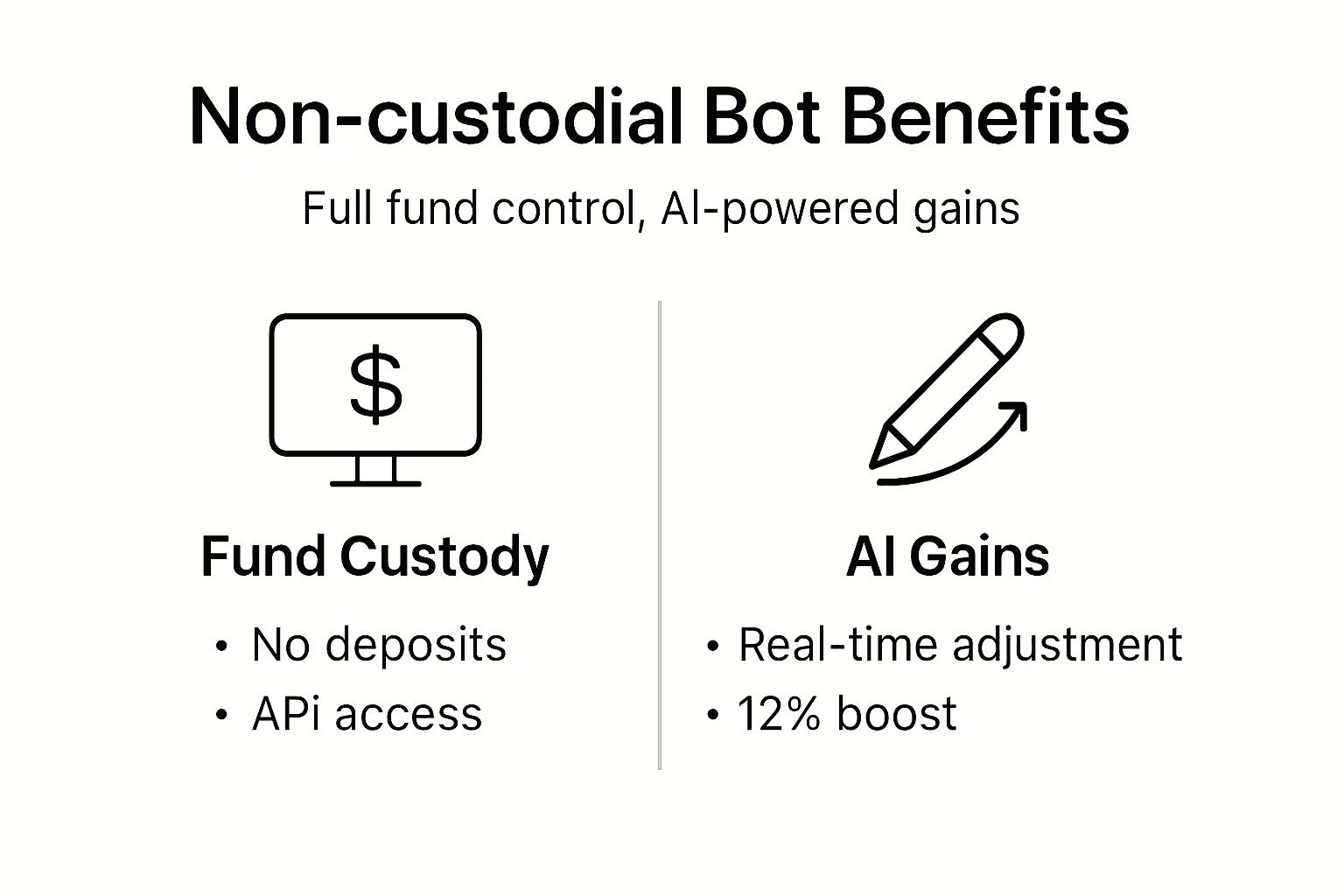
Non-custodial bots: 100% fund control & 12% AI gains

Most traders assume non-custodial automated execution sacrifices speed for security. That’s a myth. Modern API-driven systems deliver sub-100 millisecond latency while keeping every dollar under your direct control on the exchange. You gain AI-enhanced iteration, multi-venue alpha, and rule-based precision without transferring a single token to a third party. This guide unpacks how non-custodial architecture combines custody, performance, and intelligent automation to transform your perpetual DEX trading.
Table of Contents
- Understanding Non-Custodial Architecture
- Automated Execution Mechanism In Non-Custodial Platforms
- Venue-Specific Strategy Adaptation
- Iteration And Optimization In Non-Custodial Systems
- Risk Management In Automated Execution
- Common Misconceptions In Non-Custodial Trading
- Benefits Of Non-Custodial Automation For Traders
- Discover Mithril’s Non-Custodial Automated Trading Solutions
- Frequently Asked Questions About Non-Custodial Automated Trading
Key takeaways
| Point | Details |
|---|---|
| Non-custodial design ensures 100% user fund custody | Your assets remain on your exchange account at all times, eliminating counterparty risk. |
| API-based execution enables direct control | Bots place orders via your API keys without ever touching your funds, achieving institutional-grade speed. |
| AI-assisted tools improve net returns by 8-12% | Real-time strategy optimization adapts to market shifts faster than manual adjustments. |
| Different DEX venues require tailored strategies | Execution logic and fee structures vary, creating unique alpha opportunities per platform. |
| Embedded risk controls safeguard automated trading | Stop-loss orders and position refresh logic protect capital without compromising custody. |
Understanding non-custodial architecture
Non-custodial trading means you retain 100% custody of your funds on your own exchange account. No intermediary holds, freezes, or accesses your capital. This eliminates the counterparty risk inherent in custodial models where platforms pool user funds. When an exchange collapses or restricts withdrawals, custodial users lose everything.
Custodial systems require trust. You deposit funds into a shared pool, hoping the platform remains solvent and honest. Non-custodial systems remove that hope. Your API keys grant read and execute permissions, but never withdrawal rights. The bot places orders directly on your account. The exchange sees you, not a middleman.
Security and control benefits are immediate. You can revoke API access instantly if something feels wrong. Your capital never enters a black box. This comparison of non-custodial vs custodial trading systems shows how architecture affects risk exposure.
A common misconception conflates decentralization with non-custody. Decentralized exchanges are non-custodial by design because trades execute peer-to-peer via smart contracts. But automated trading on perp DEXs often uses centralized infrastructure with non-custodial trading explanation at Gemini preserving user custody through API-only access.
Key principles of non-custodial architecture:
- Funds remain in user-controlled exchange accounts at all times
- API keys provide execution permission without withdrawal access
- Bots operate as agents, not custodians
- Users retain unilateral power to halt or revoke automation
This foundation makes automation trustworthy. You control the capital. The bot controls the execution.
Automated execution mechanism in non-custodial platforms
API keys are the bridge between your strategy and the market. You generate a key pair on your perp DEX account. The key grants specific permissions: read market data, place orders, cancel orders. It does not permit withdrawals. You hand this key to your bot, and the bot acts as your tireless execution agent.
Funds never leave your custody during automated execution onboarding with Mithril bots. When your strategy signals a long position, the bot submits the order directly to your exchange via API. The exchange debits your margin, opens the position, and credits profits or losses to your account. The bot never touches the money.
Perp DEXs supporting API-based non-custodial trading include Hyperliquid, dYdX, and GMX. Each platform offers REST or WebSocket APIs. Latency matches custodial execution because the bot connects directly to exchange infrastructure. Sub-100 millisecond order placement is standard. You sacrifice nothing in speed.
This mechanism enables institutional-grade automation for retail traders. You deploy automated bot frameworks for non-custodial trading without building custom engines or managing servers. The platform handles infrastructure. You handle strategy.
Pro Tip: Use read-only API keys for secure non-custodial trading whenever possible. Many platforms let you create keys with trade execution but no withdrawal access. This adds a final layer of protection if your key leaks.
API-driven execution removes emotional interference. The bot follows rules. It doesn’t panic during dumps or chase pumps during euphoria. It executes your logic perfectly, every time, without hesitation or second-guessing.

Venue-specific strategy adaptation
Not all perp DEXs are created equal. Execution logic differs. Hyperliquid uses an order book model with maker-taker fees. GMX relies on a liquidity pool with dynamic pricing. dYdX offers cross-margin and isolated margin modes with distinct funding rate calculations. These differences matter.
Your funding arbitrage strategy might crush on Hyperliquid but bleed fees on GMX. A market-making bot tuned for dYdX’s order book may fail on GMX’s pool-based pricing. Non-custodial bots let you adapt parameters per venue without moving capital. You deploy different logic on each platform, all controlled from one interface.
Here’s how venue characteristics shape strategy:
| Venue | Execution Model | Fee Structure | Strategy Implication |
|---|---|---|---|
| Hyperliquid | Order book | Maker rebate, taker fee | Favor limit orders and market making |
| GMX | Liquidity pool | Flat execution fee | Prioritize directional plays over scalping |
| dYdX | Order book | Tiered maker-taker | Exploit funding rate spreads with high frequency |
| Vertex | Hybrid | Dynamic spreads | Adapt to liquidity conditions in real time |
Multi-venue operation unlocks alpha through portfolio diversification. You capture funding on dYdX, make markets on Hyperliquid, and run grids on GMX simultaneously. Each venue contributes uncorrelated returns. When one market dries up, another heats up.
Benefits of guide to multi-venue strategy adaptation:
- Reduced single-venue risk and exposure concentration
- Access to unique opportunities per platform’s execution mechanics
- Higher aggregate returns from diversified strategy deployment
- Flexibility to shift capital allocation without custody transfer
Venue-specific tuning is how advanced traders extract edge. The same strategy behaves differently on each platform. Non-custodial design lets you exploit those differences without security trade-offs.
Iteration and optimization in non-custodial systems
Markets change. Volatility spikes. Funding rates flip. Your bot needs to adapt or die. AI-powered tools monitor execution in real time, analyzing fills, slippage, and profitability. When performance degrades, the system suggests parameter adjustments.
AI-assisted iteration monitors bot performance in real-time, suggesting parameter tuning that can improve net trading returns by approximately 8-12% over manual adjustments. The AI doesn’t trade for you. It enhances your decisions by surfacing patterns you’d miss manually. You stay in control.
Continuous monitoring tracks every order. Did your market-making bot get picked off during a volatility spike? The AI flags it and recommends wider spreads. Is your funding arb bot underperforming because rates compressed? The system suggests reallocating capital to grid strategies. You review, approve, and deploy.
Benefits of AI-driven iteration:
- Faster response to market regime changes than manual oversight
- Reduced emotional bias in strategy adjustment decisions
- Higher compound returns through incremental optimization
- Lower operational overhead from automated performance analysis
Pro Tip: Combine AI suggestions with manual oversight. The AI excels at pattern detection and speed, but you bring context and risk appetite. Review every recommendation before deployment. Trust the data, but verify the logic.
AI-powered strategy optimization tools turn iteration from a chore into a competitive edge. You iterate faster than competitors stuck in manual workflows. Your strategies evolve. Theirs stagnate.
Risk management in automated execution
Automation without risk controls is gambling. Embedded safeguards prevent catastrophic losses while maintaining non-custodial custody. Your bot includes stop-loss orders, position refresh logic, and safety thresholds. These tools act as circuit breakers when markets turn hostile.
Stop-loss orders close positions automatically when losses exceed a predefined threshold. If your long position drops 5%, the bot exits. No phone calls. No hesitation. Just execution. This removes the emotional paralysis that causes retail traders to ride losing positions into the ground.
Position refresh logic rebalances exposure dynamically. If your market-making bot accumulates inventory skew, refresh logic closes the imbalance and resets to neutral. This prevents runaway exposure that could liquidate your account during a flash crash.
Safety thresholds define operational boundaries. Maximum position size, daily loss limits, and margin utilization caps keep your bot within safe parameters. When a threshold breaches, the bot halts and alerts you. You investigate, adjust, and resume.
Risk controls reduce secure crypto exchange management techniques system failures and human error. The bot doesn’t freeze during a liquidation cascade. It executes your predefined risk rules without emotion or delay.
Essential trader practices for maintaining risk discipline:
- Set stop-loss thresholds based on volatility, not arbitrary percentages
- Review position refresh logic weekly to ensure alignment with market conditions
- Monitor margin utilization and adjust safety caps as account size grows
- Test risk controls in simulation before deploying live capital
Non-custodial design limits external risk, but internal risk management is your responsibility. The platform can’t save you from bad strategy design. Embedded controls help, but you must configure them correctly.
Common misconceptions in non-custodial trading
Myths prevent adoption. Let’s correct the record with evidence.
-
Non-custodial bots are slower than custodial systems. False. API-based execution achieves sub-100 millisecond latency because bots connect directly to exchange infrastructure. Custodial systems add an intermediary layer, often increasing latency. Debunking latency myths in non-custodial bots confirms that modern APIs eliminate the speed penalty.
-
You lose control of your funds during automation. False. Your API keys grant execution permission only. The bot cannot withdraw, transfer, or freeze your capital. You retain unilateral control. Revoke the API key, and the bot goes silent instantly.
-
AI in non-custodial bots is a black box you can’t trust. False. AI-assisted tools surface transparent recommendations with data-backed reasoning. You review every suggestion. The AI doesn’t execute trades without your approval. It augments your decision-making, not replaces it.
-
Non-custodial automation requires technical expertise. False. Platforms abstract infrastructure complexity. You select strategies, configure parameters, and deploy. No coding. No server management. The interface resembles setting up a trading view alert, not building a data center.
-
If the platform fails, your bots stop but your funds are safe. True. This is a feature, not a bug. Platform downtime halts automation, but your capital remains on the exchange under your control. You can trade manually or migrate to another bot provider without moving funds.
Clarity kills hesitation. These misconceptions evaporate under scrutiny. Non-custodial automation is fast, secure, transparent, and accessible.
Benefits of non-custodial automation for traders
Rule-based execution reduces emotional trading errors by over 40%. You define entry, exit, and risk parameters. The bot follows them perfectly. No FOMO. No panic selling. No revenge trading after losses. Automation enforces discipline.
Infrastructure management vanishes. You don’t provision servers, monitor uptime, or debug API connections. The platform handles operations. You focus on strategy development and alpha generation. Your time shifts from maintenance to edge discovery.
Execution speed improves. Bots react to market signals in milliseconds. You can’t. By the time you notice a funding rate spike and manually enter a position, the opportunity is gone. The bot captures it instantly.
Capital security strengthens. Funds stay under your direct control. No custody risk. No platform insolvency exposure. No withdrawal freezes. You trade with institutional-grade automation while maintaining retail-level custody.
Key benefits summary:
- Emotional bias elimination through consistent rule execution
- Operational simplicity by outsourcing infrastructure to the platform
- Faster market response times compared to manual trading
- Direct fund custody reducing counterparty and platform risk
- Increased confidence from transparency and unilateral control
Non-custodial automation transforms trading from a reactive, emotional activity into a proactive, systematic discipline. You gain the precision of institutions without surrendering the autonomy of self-custody.
Discover Mithril’s non-custodial automated trading solutions
Mithril turns trading ideas into live, non-custodial execution in seconds. Our platform acts as the execution layer between you and perp DEXs. You retain 100% fund control while Mithril handles strategy logic, automation, risk management, and AI-powered iteration.
We support delta-neutral funding arbitrage, market making, grid trading, and directional strategies across multiple venues. Each opportunity is curated, each bot includes embedded risk controls, and each deployment preserves your custody. Start with our get started with Mithril non-custodial bots process. Explore guide to optimizing automated strategies to refine performance. Visit Mithril Money automated trading platform to see how hundreds of traders already use our system to automate execution without sacrificing control. Focus on the idea. Mithril handles the execution.
Frequently asked questions about non-custodial automated trading
What does non-custodial mean in automated trading?
Non-custodial means your funds remain in your own exchange account at all times. The bot accesses your account via API keys that permit order execution but never withdrawal. You retain unilateral control and can revoke access instantly.
How is fund safety ensured if the platform never holds my assets?
Safety comes from architecture, not trust. API keys grant execution-only permissions. The platform cannot withdraw, transfer, or freeze your capital. Even if the platform fails, your funds stay safe on the exchange under your direct control.
Can AI in non-custodial bots replace manual strategy management?
AI augments your decisions but doesn’t replace them. It monitors performance, detects patterns, and suggests parameter adjustments. You review and approve every change. The AI accelerates iteration speed without removing your oversight.
Are there latency drawbacks in non-custodial execution?
No. API-based non-custodial bots achieve sub-100 millisecond order placement by connecting directly to exchange infrastructure. Latency matches or beats custodial systems because there’s no intermediary processing layer.
How do I manage risk while automating trades across multiple DEX venues?
Use embedded risk controls like stop-loss orders, position refresh logic, and safety thresholds. Set venue-specific parameters based on liquidity and volatility. Monitor aggregate exposure and adjust capital allocation dynamically to prevent concentration risk.